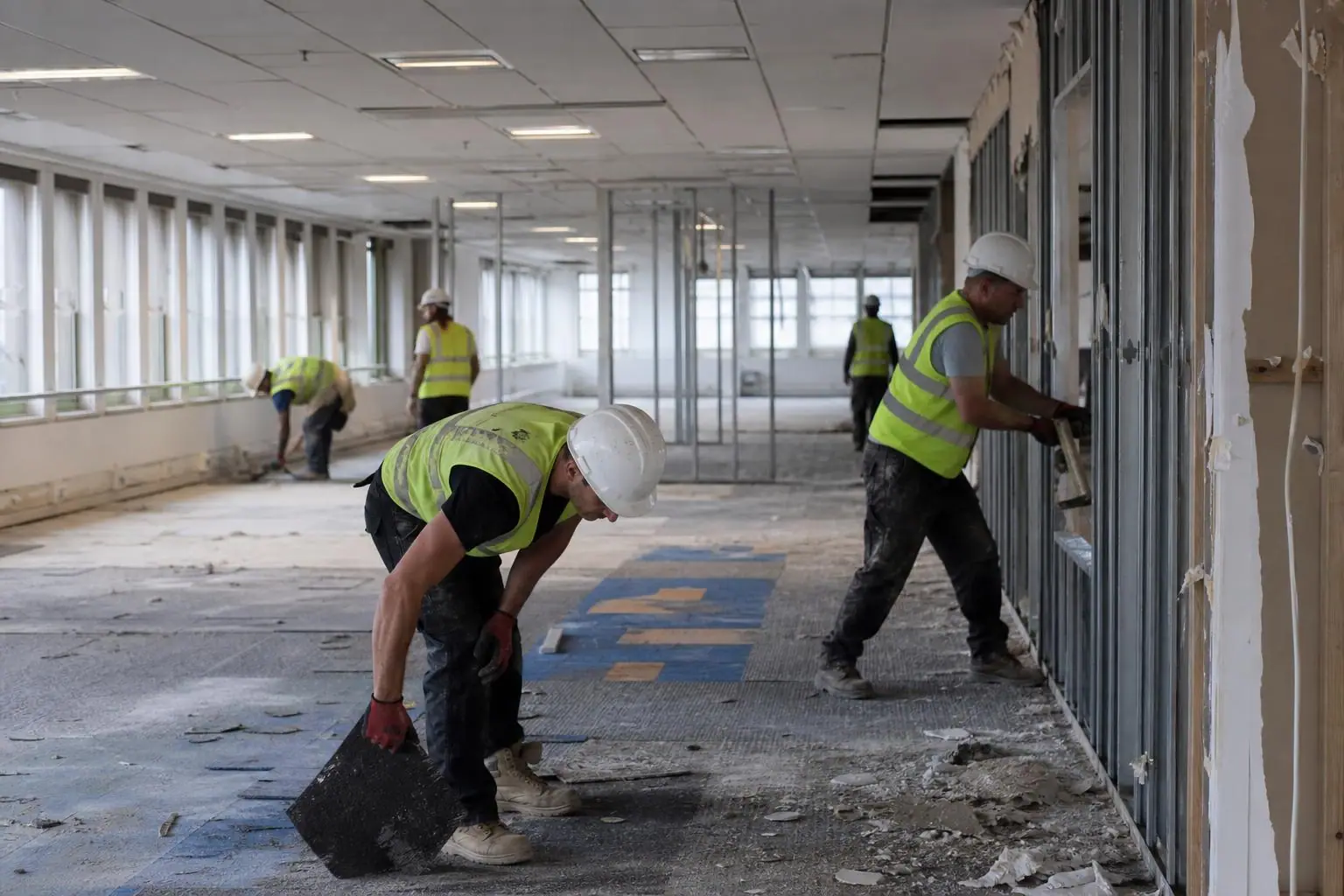
The Brief
Soft Strip Demolition London — Controlled Internal Strip-Outs
Vehicall Transport delivers professional soft strip demolition across London and the Home Counties — the controlled, non-structural removal of all internal fixtures, fittings, finishes, partitions, ceilings, flooring, services and M&E ahead of refurbishment, fit-out or full demolition. Unlike hard demolition, soft strip preserves the structural shell of the building while clearing everything inside down to slab and superstructure.
Our CSCS-carded, SMSTS-supervised crews work on offices, retail units, restaurants, hotels, schools, hospitals and industrial premises — from single-floor Cat-A reinstatements in the City of London to multi-storey strip-outs across Hertfordshire and Bedfordshire. Every project includes a documented RAMS pack, asbestos R&D survey review, segregated skips, weighbridge tickets and a 98% landfill-diversion guarantee with full Waste Transfer Notes.
What is soft strip demolition?
Soft strip demolition (sometimes called "internal strip-out", "fit-out strip" or "non-structural demolition") is the first phase of any commercial refurbishment, dilapidations programme or hard-demolition project. The objective is simple: take the building back to its structural shell — slab, columns, frame and external envelope — while every other item inside is removed, segregated and routed to recycling, reuse or licensed disposal.
Unlike hard demolition (which uses excavators, breakers and explosives to bring structure down) soft strip is a precise, low-vibration process carried out by hand and small power tools. That makes it ideal for occupied buildings, listed structures, party-wall sensitive sites and projects where the existing slab and façade are being retained for the new fit-out.
When do you need soft strip demolition?
- Office CAT-A reinstatement — clearing tenant CAT-B fit-out at lease end so the landlord can re-let.
- Retail rebrand or unit refit — stripping out shopfit ahead of a new tenant moving in.
- Restaurant & hospitality — removing kitchens, bars, banquette seating and signage between operators.
- Hotel refurbishment — floor-by-floor strip-outs while the rest of the hotel keeps trading.
- Schools & healthcare — phased strip-outs during summer holidays or low-occupancy windows.
- Industrial & warehouse — clearing racking, mezzanines and M&E for a new occupier.
- Pre-demolition — stripping the building back before hard demolition crews bring the shell down.
Soft strip vs hard demolition — the key differences
The most common question we get asked is "do I need soft strip or hard demolition?" The honest answer is usually both, in sequence. Hard demolition almost always begins with a soft strip — without it, valuable recyclables (copper cable, steel partitions, brass fittings, ceiling tiles) end up crushed in the rubble and lost. Soft strip captures every reusable element, dramatically improves landfill-diversion KPIs, and leaves the structure clean and safe for the heavy plant to follow.
For projects where the structure is being kept (CAT-A reinstatement, refurbishment, change of use), soft strip is all you need. For projects where the building is coming down, soft strip should always come first — typically saving 15-30% off the combined disposal bill thanks to recovered scrap value.
Recycling, weighbridge tickets and Waste Transfer Notes
Vehicall Transport operates an Environment Agency upper-tier waste carrier licence (CBDU571842). Every load leaves site with a serialised Waste Transfer Note, EWC code and the destination MRF (materials recovery facility). On request we issue a full project recycling certificate showing tonnage diverted from landfill against tonnage incinerated or landfilled — typical results across our 2024–2026 projects sit at 96–99% diversion, well above the BREEAM and SKA Rating benchmarks.
Materials are segregated on site into colour-coded skips: ferrous metal, non-ferrous metal, gypsum (plasterboard), ceiling tiles, raised floor panels, timber, cabling, MDF/joinery, mixed inert and general waste. Our supply chain is audited annually under ISO 14001 and we share weighbridge tickets with your sustainability team in real time via shared cloud folder.
Health, safety and accreditations
Every Vehicall site operates under a written RAMS pack signed off before any tools start. Site competence cards and supervisor qualifications are confirmed for each project before work starts. We carry £2m public liability and £10m employer's liability insurance. Our asbestos competence is non-licensed (NNLW) — for licensable removals we appoint our HSE-licensed partner under a single-point contract.
Soft Strip Demolition — In Action
Real Jobs, Real Crews
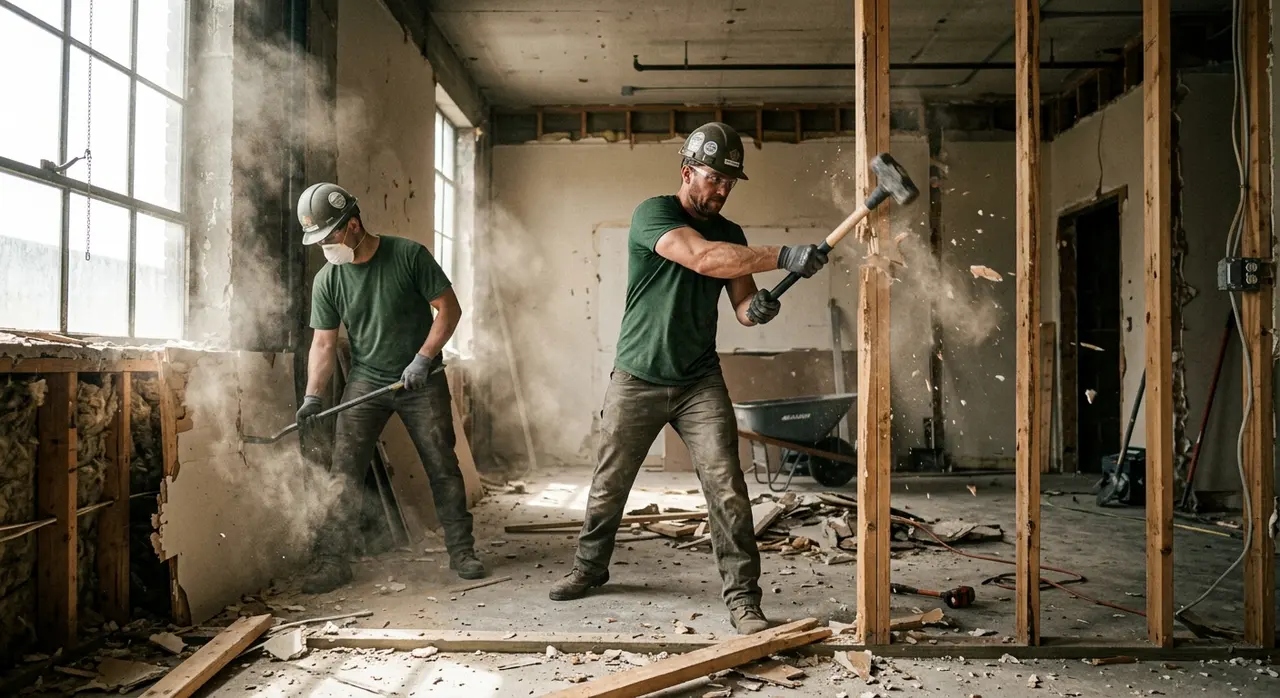
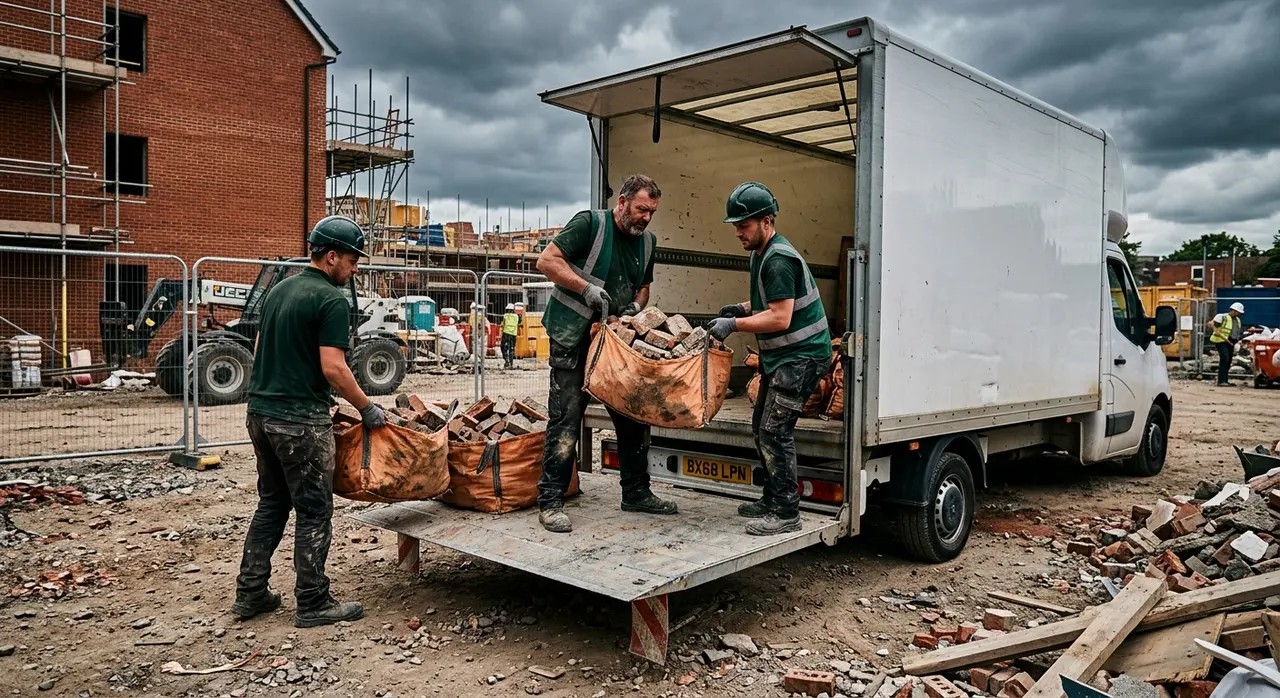
On-the-day imagery from Vehicall soft strip demolition across London and the Home Counties.
Fixed Pricing
Transparent Pricing
Fixed prices, no hidden fees. Every quote includes labour, transport, fuel and licensed disposal with a Waste Transfer Note.
Office Strip-Out
From £15/m²
Capacity: Per floor or whole building
Partitions, ceilings, raised floors, M&E first-fix removal, CAT-A reinstatement
Retail & Hospitality
From £18/m²
Capacity: Single units to chains
Shopfittings, fixtures, commercial kitchens, bars, signage, end-of-lease handback
Industrial / Large Scale
POA
Capacity: 1,000m² – 50,000m²+
Warehouses, schools, hospitals, listed buildings — phased programmes available
All quotes include skips, labour, PPE, RAMS, waste transfer notes and weighbridge documentation. Out-of-hours and weekend programmes available.
The Difference
Why Vehicall
Fully Insured
£2m public liability and £10m employer's liability insurance.
98% Landfill Diversion
Materials sorted on-site: metals, gypsum, timber, ceiling tiles and cabling all recovered.
Full Documentation
Pre-start RAMS, asbestos R&D review, daily site reports, weighbridge tickets, WTNs.
Programme-Driven
We hit fit-out programmes — out-of-hours, weekends and phased handovers as standard.
Included
What We Take
- Suspended ceilings & ceiling tiles (mineral fibre, metal, plasterboard)
- Raised access floors & screed
- Stud partitions, glazed partitions & demountable walls
- Floor coverings — carpet, vinyl, LVT, parquet
- Kitchens, sanitaryware, WC pods & shower cubicles
- M&E first-fix — cable trays, containment, ductwork, pipework
- Light fittings, AC units, fan coil units, extract systems
- Joinery, doors, frames, ironmongery, balustrades
- Shopfittings, retail fixtures, signage and cladding
- Loose furniture, FF&E, IT equipment (WEEE-compliant)
Excluded
What We Can't Take
- Notifiable asbestos (we work alongside HSE-licensed asbestos removal partners)
- Live electrical or gas isolation (must be made safe by client's M&E contractor first)
- Structural elements (load-bearing walls, slabs, columns — that's hard demolition)
- Hazardous chemicals or unidentified drums (specialist removal required)
The Process
How It Works
Site Survey
Free pre-tender visit, asbestos R&D review, scope of works and fixed-price quotation.
RAMS & Mobilisation
Method statements, risk assessments, permits and welfare set-up before any tools start.
Phased Strip-Out
Top-down or zone-by-zone removal, segregated skips, daily progress reports to your PM.
Recycling & Disposal
On-site sorting, weighbridge tickets, Waste Transfer Notes and recycling certificates.
Handover
Slab-clean handback ready for follow-on trades, CAT-A reinstatement or hard demolition.
Territories
Areas We Cover
Same-day and next-day soft strip demolition across London and the Home Counties.
Answers
Frequently Asked
What is soft strip demolition?+
Soft strip demolition is the controlled, non-structural removal of all internal finishes, fixtures, fittings, partitions, ceilings, M&E and FF&E from a building — leaving the structural shell intact. It's the essential first phase before any commercial fit-out, refurbishment or hard demolition.
How is soft strip different from hard demolition?+
Hard demolition removes the structure itself — slabs, columns, walls, frames. Soft strip removes only what's inside the structure. Soft strip is quicker, cleaner, recovers more materials for recycling and is required before hard demolition can begin safely.
How much does soft strip demolition cost?+
Pricing typically ranges from £15/m² for straightforward office strip-outs to £25/m²+ for retail, hospitality or buildings with complex M&E. We always provide a fixed-price quotation after a free site survey — no day-rate creep.
How long does a soft strip take?+
A 500m² single-floor office can typically be stripped in 5–10 working days. A multi-storey building can be phased to suit your fit-out programme. We work nights, weekends and bank holidays to hit critical handover dates.
What about asbestos?+
We always review the building's asbestos R&D survey before starting. Notifiable asbestos must be removed by an HSE-licensed contractor (we work alongside trusted partners). Non-licensable items can be handled in-house under the correct controls.
Do you handle CAT-A reinstatement?+
Yes — many of our strip-out projects roll directly into CAT-A reinstatement: new ceilings, raised floors, lighting, primary M&E and shell finishes ready for the incoming tenant's CAT-B fit-out.
Are you insured for commercial demolition work?+
Yes. We carry £2m public liability and £10m employer's liability insurance. Ask us for the certificates with your quote.
Where do you cover?+
Across all 32 London boroughs and the Home Counties — Hertfordshire, Bedfordshire, Buckinghamshire, Essex, Surrey, Berkshire, Cambridgeshire and beyond. National projects considered.
Explore More
Related Services
By Location
Soft Strip Demolition Network
Local crews across 176+ towns in London, Hertfordshire, Bedfordshire, Buckinghamshire and the Home Counties.
Get Your Free Quote Today
Licensed waste carrier CBDU571842 · Fully insured · 1,000+ successful jobs